
- 5.0 ★ · 1,639
 reviews
 - PADI & SDI dive center in Playa del Carmen
- Max. 4 guests per guide
- Free transport within Playa del Carmen
- Clear prices, no hidden costs
- 5 Star Instructor Training Facility
Key facts at a glance
- Season
- Mid-November to end of February, best sightings December/January
- Depth
- Encounter zone 22–25 m (72–82 ft), dive site down to 28 m (92 ft)
- Requirement
- At least Advanced Open Water Diver
- Price
- 150 € for 1x bull shark + 1x reef (second dive free)
- Feeding
- None – deliberately without bait
Want to see them yourself?
Bull shark diving: 1 shark + 1 reef dive, 150 € →General Information: Bull Sharks Playa del Carmen Guide
Every winter, pregnant female bull sharks move in close to the coast of Playa del Carmen. If you time it right, you can encounter them just a few metres away. Here’s the short answer up front: the season runs from mid-November to the end of February, and the most reliable sightings are in December and January. Yes, under these conditions we consider the dive safe — more on that in a moment.
If you’re reading “bull shark” and “Playa del Carmen” in the same sentence for the first time, you’ll usually stumble over the animal’s reputation first. Many travel blogs and listicles often sensationalise the bull shark as one of the “most dangerous shark species in the world”. The reason is usually that it lives in shallow, murky coastal water and occasionally encounters swimmers or surfers there. However, this isn’t because it’s naturally more aggressive than other sharks.
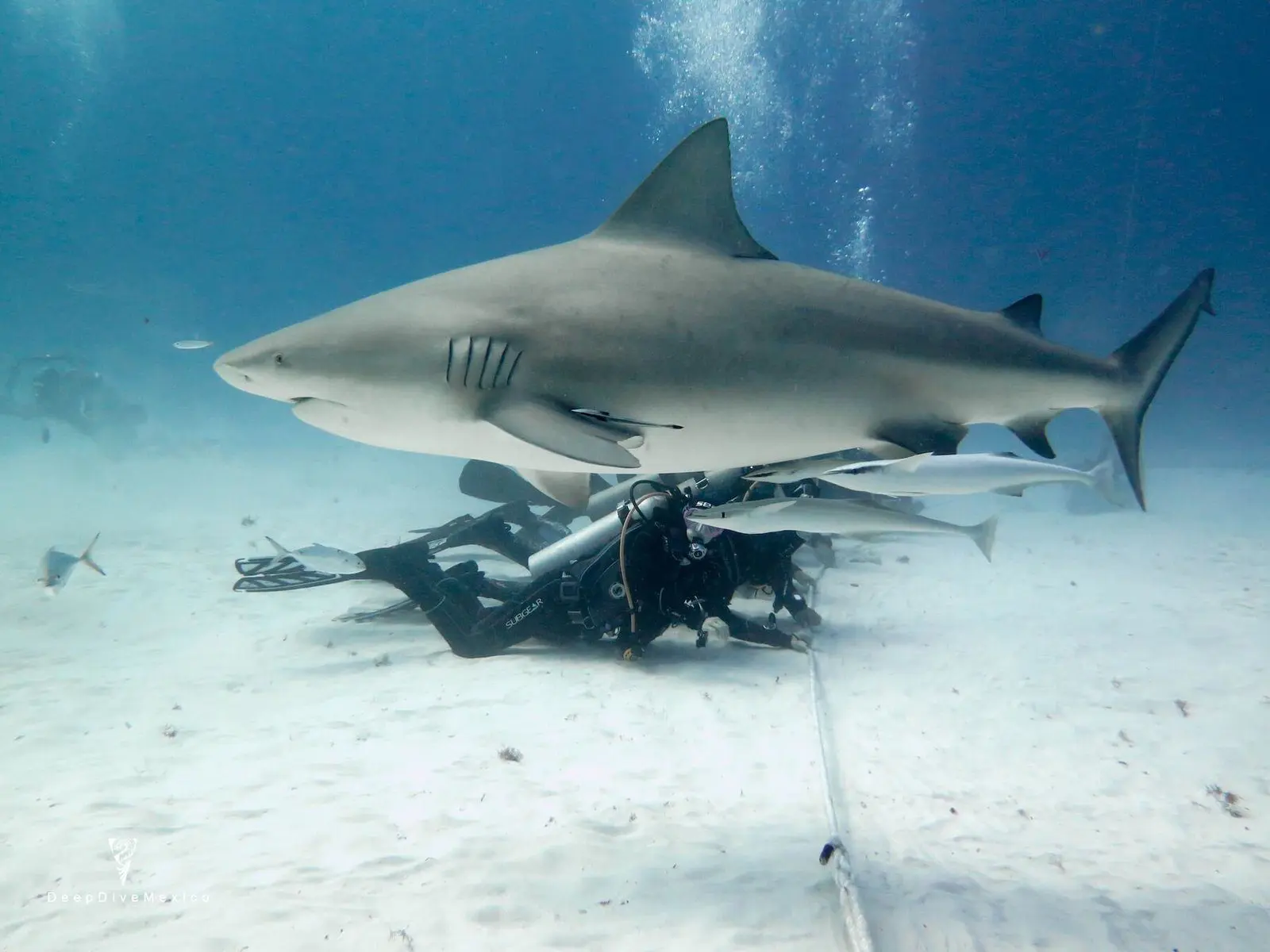
In reality, that exact context — murky water, poor visibility, close to shore — has little to do with the situation at Bull Shark Point off Playa del Carmen. Here, we encounter resting, pregnant females in clear water, with no feeding, no bait, and no prey nearby. Two very different situations that are often lumped together online. That’s the real reason the topic sounds far scarier than it actually is here.
When is bull shark season in Playa del Carmen?
The season starts in mid-November and ends in late February, with the most reliable window between December and January. During these months, the water temperature off the coast drops slightly, and pregnant females move in from the open ocean — presumably to rest and give birth. Outside this period, bull sharks at our dive site aren’t impossible, but they’re not to be expected; we then switch to other open-water spots.
Where exactly: Bull Shark Point
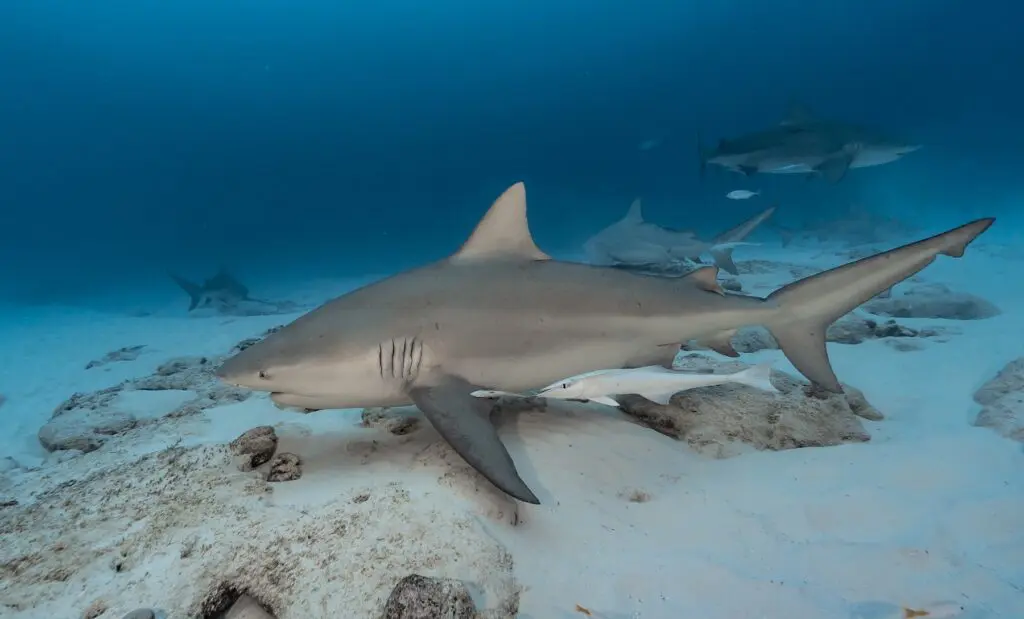
The site sits a short boat ride from Playa del Carmen — a wide, sandy area with a gently sloping depth between 14 and 28 meters (92 ft). The actual encounter zone is 22 to 25 meters (72–82 ft), where the females prefer to stay. We descend along a line to the sandy bottom — an advantage rather than a problem when there’s current.
How dangerous is this dive, really?
Short version: under the conditions here, the risk is low, even though “dangerous” never fully drops to zero with a wild animal. There’s no feeding, no bait, and we train divers to stay deliberately passive — arms crossed, breathing slow, no active approach. That alone removes most of the reason for the sharks to take any interest in the group. In practice, it plays out the same way almost every time: the sharks come in out of curiosity, circle a few times, and lose interest within minutes. Meanwhile, the group stays put on the sand and watches.
Our take on this is straightforward: dives that use fish or bait to guarantee close-up shots change the animals’ natural behavior. If anything, that practice raises the risk rather than lowering it. That’s why we don’t feed, full stop, even though some other operators in the region do. It means no guaranteed dramatic close-ups, but a dive that stays closer to genuine wild behavior. In our view, it’s the only responsible way to dive with an animal that’s in a particularly sensitive stage of its life right now.
Rules we enforce at Bull Shark Point
- Stay calm, keep distance — no sudden movements, no actively swimming toward the animals.
- Body position on the bottom — kneel or lie still and let the sharks approach.
- Secure your hair — loose hair gets covered with a hood or head covering.
- No bright colors — gear stays neutral or dark to avoid drawing unnecessary attention.
Size and biology: what makes the bull shark unusual
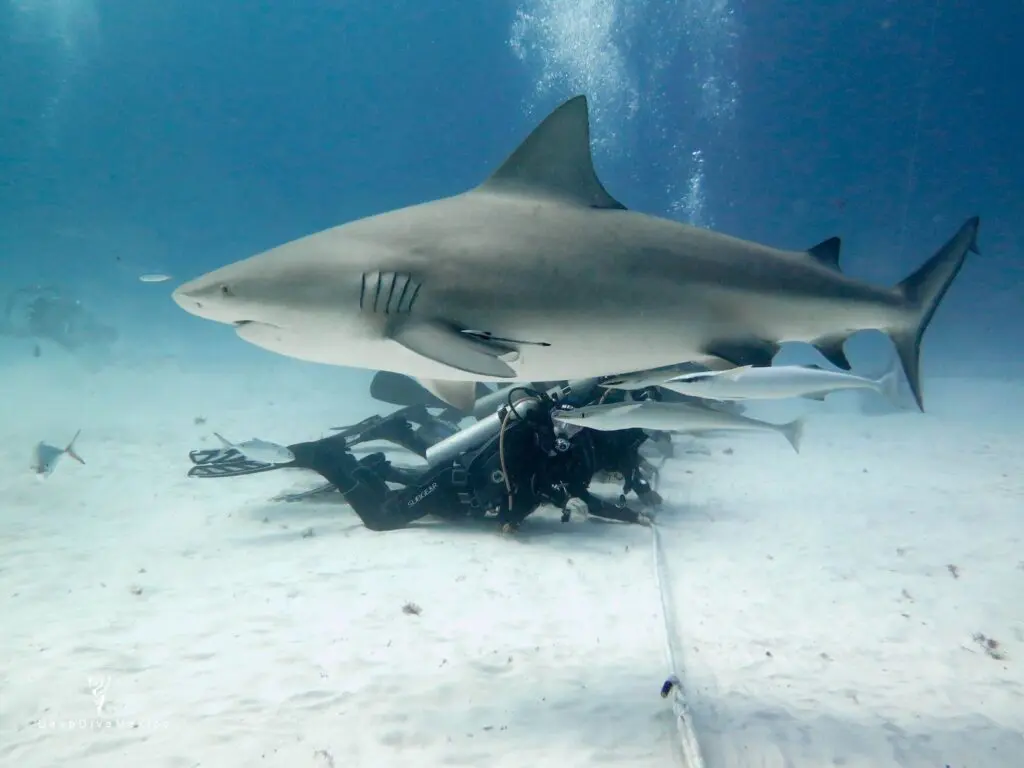
The bull shark (Carcharhinus leucas) reaches a total length of around 2.2 meters (7 ft) and roughly 120 kg at our site. Unlike many other shark species, it doesn’t lay eggs. Instead, it carries its young in the uterus for up to eleven months before giving birth to 1 to 13 pups, who are then immediately on their own. That reproductive strategy also explains why we see almost exclusively pregnant females off Playa del Carmen: they’re not here to hunt, they’re here to rest.
What the dive with us looks like
We meet at 7:00 AM, followed by a thorough briefing on the animals’ behavior and the site rules. After a short boat ride to Bull Shark Point, we descend the line to 22–25 meters (72–82 ft). The group spends around 30 minutes on the sandy bottom. That’s plenty of time to observe the sharks from 5 to 6 meters (16–20 ft) away without crowding them. If you’ve booked Nitrox and hold the right certification, you dive with it for free — a real advantage on a deep dive like this one.
Requirements
At least Advanced Open Water Diver (AOWD), since the dive goes down to 28 meters (92 ft). We don’t require a minimum number of logged dives beyond that — if you don’t have your AOWD yet, you can get certified with us in Playa del Carmen beforehand.
Cost
A bull shark dive with us costs 150 € per person: 1 bull shark dive plus 1 reef dive, the second dive is free, with free Nitrox for certified divers. Season dates, requirements and booking are on our bull shark diving in Playa del Carmen page – run by our dive center in Playa del Carmen with max. 4 divers per guide. You’ll find the current, binding price list on our price page.
More Blog Articles
More insights into PADI or SDI and other exciting diving topics in Playa del Carmen.
Bull Shark Guide
Where and when you can see them
Sea Turtle Guide
Where and when will you meet them?
Reef Guide
Which reef suits you?
Absolut Cenote Guide
Which Cenote is the best for you?
Scuba Certification
Cost, duration & requirements
PADI or SDI?
The difference explained
Foggy Scuba Mask
Why it happens and what helps
Packing List
The complete checklist
Best Time to Dive
When to plan your dive trip
SDI or PADI IDC
Become a Dive Instructor
Rescue Diver Course
PADI or SDI – Cost & Requirements
Advanced Open Water Diver
Cost, Depth & Course
Frequently asked questions
Is this type of diving dangerous?
Under controlled conditions with no feeding, clear behavioral rules, and an experienced guide, the risk is low. Some residual risk always remains with a wild animal, but this isn’t an unpredictable dive.
What certification do I need?
At least Advanced Open Water Diver, since the site reaches depths of up to 28 meters (92 ft).
When is bull shark season in Playa del Carmen?
Mid-November through the end of February, with the most reliable sightings in December and January.
Are they fed?
No. We deliberately dive without feeding or bait to keep the animals‘ natural behavior intact.
How deep do we dive at Bull Shark Point?
Depending on the animals‘ behavior, the depth ranges between 20 and 28 meters (92 ft).
Ready for your dive adventure in Mexico?
Tell us what you have in mind – you will receive a personal quote within 24 hours, usually much faster.
★★★★★ 5.0 out of 5 · 1,639 Google reviews
★★★★★ 5.0 out of 5 · 362 Tripadvisor reviews
☎ +49 15678 310825 · Daily 8:00 am–5:00 pm